
16: The Vanishing Point / Past Future Continuous
On Bani Khoshnoudi's The Vanishing Point (2025) and Morteza Ahmadvand and Firouzeh Khosrovani's Past Future Continuous (2025), and on homes and homelands
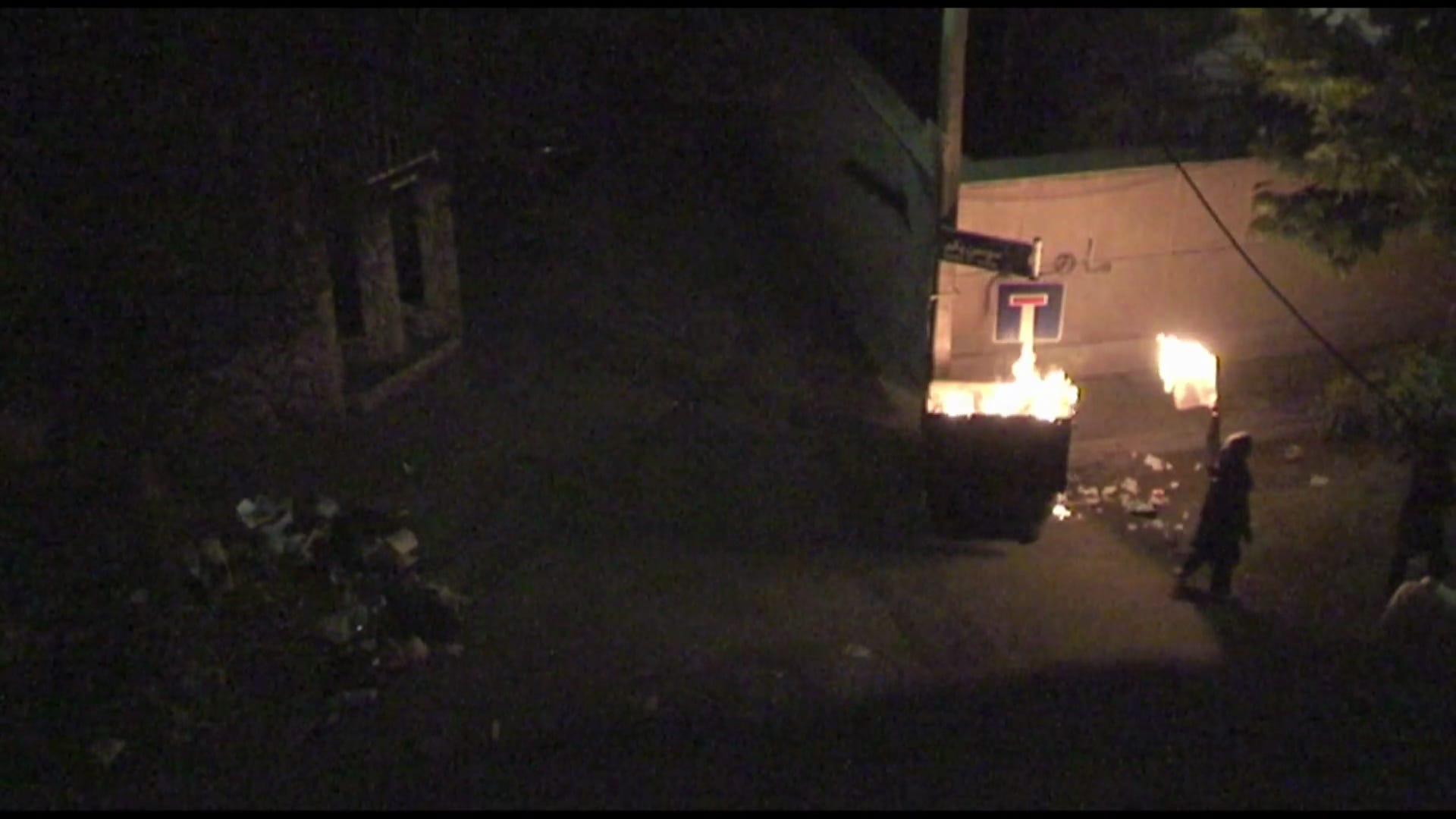
“Behind me was my home, and, in front of me, darkness”
A home can be many things, but above all, it should be a place of peace and comfort. But how does a space change when it ceases to signify what it used to? And what does it mean to document a home that you can no longer visit? Two films, both made by Iranian filmmakers working outside of Iran, raise questions around home and homeland, exploring ideas of proximity and distance, of restriction and freedom, and of remembering and forgetting, examining what happens when a home is no longer familiar or even recognisable.
Bani Khoshnoudi was born in Tehran and left Iran for the United States during the Islamic Revolution in 1979. She travelled back and forth in the years that followed, but the banning of her 2010 film The Silent Majority Speaks saw her forced into exile. Depicting Iran’s “Green Movement,” that film captured protests unfolding following the country’s contested 2009 presidential election, combining on-the-ground footage shot by Khoshnoudi with the swell of mobile phone images emerging from the violently suppressed popular demonstrations. The Vanishing Point (2025) revisits this film’s form, but with Khoshnoudi operating at a distance rather than as a fly-on-the-wall participant. Made using an assemblage of diaristic materials shot by Khoshnoudi during the years she was still able to visit Iran alongside found footage drawn from various sources captured in the years since her exile, The Vanishing Point explores the filmmaker’s relationship to her ever-changing homeland. Starting by using the story of a cousin who was murdered in 1988 during Iran’s purges in political prisons as a flashpoint to examine the surrounding sense of collective self-censorship and terror in the country, the abstractly essayistic film then demonstrates, through progressive cycles of un-narrated footage advancing through to the current day, a nationwide atmospheric shift from fearful silence towards righteous vocal indignation.
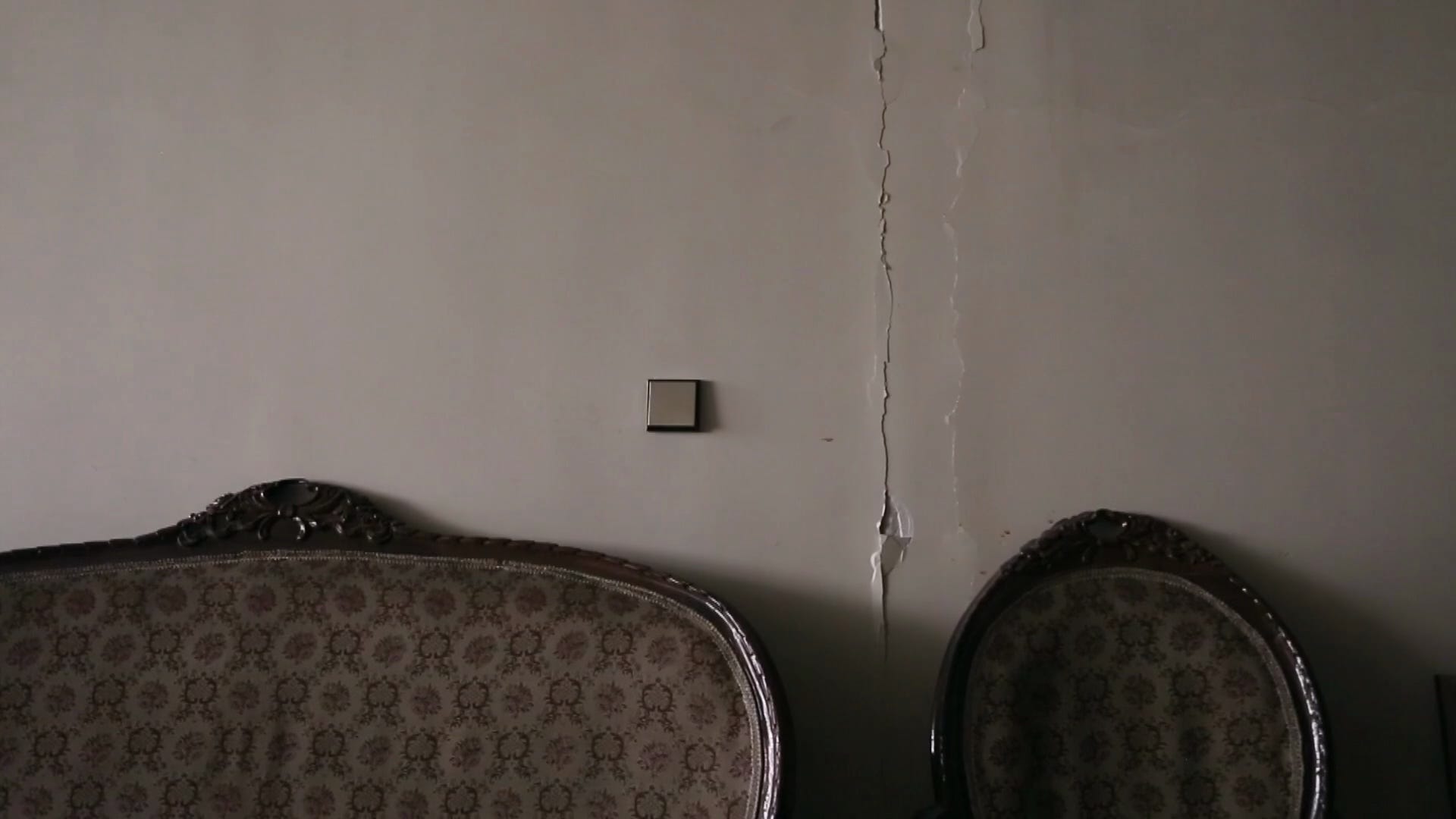
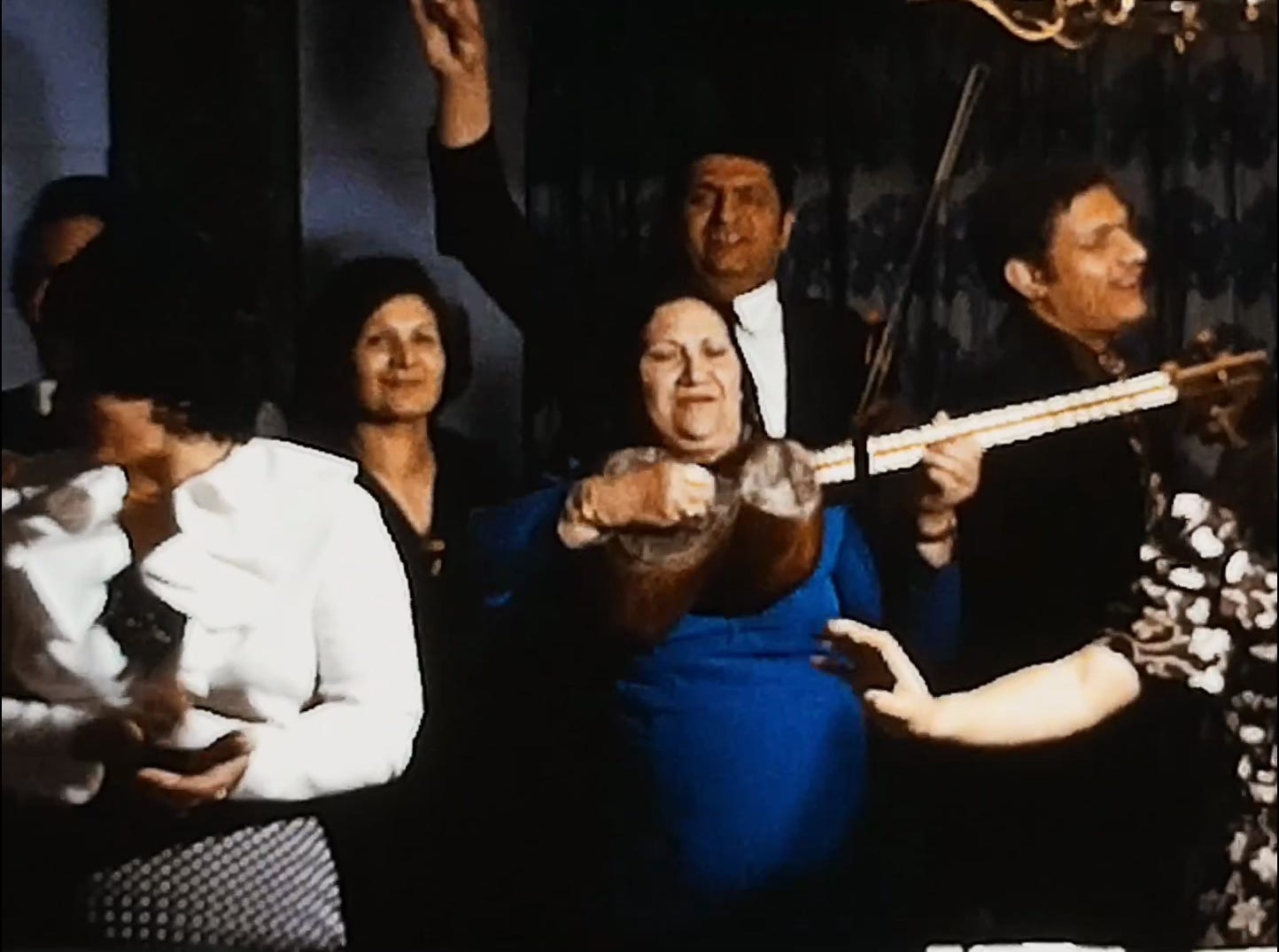
The Vanishing Point begins in the home, showing first a FaceTime call between two women, one in Iran and another abroad, both lamenting the uncrossable distance that is shortened but not closed by the imperfect connection of the video call. After this, in a rain-soaked, forlorn-feeling scene that is cloaked by a foreboding sense of quiet, we see a back garden captured in shaky handycam video camera footage. Then some Super 8 home movies showing a baby playing in the sea in a scene that, through the contrast of colour and the buoyancy of the sound, seems lighter and happier. Images that are seemingly unrelated pass by one after another, establishing a brooding tone that obliquely gestures towards the tragic. Only after ten minutes of mute images does the film’s narration arrive, gradually contextualising proceedings. Instead of overpowering images by speaking immediately for and over them, Khoshnoudi skilfully obfuscates the film’s slowly emerging narrative of pain and protest, instead dangling visual details that set a tone, showing how space becomes imbued with mood and memory but also how silence which may once have felt peaceful starts to feel suffocating when it appears to be masking something lying latent and unsaid. “In Iran, we cannot breathe outside of the home as we do indoors,” Khoshnoudi says in the film’s sparse, pointed narration. “When you speak what you think, you never know who might be listening.” But, as the film later reveals, in a dictatorship, it’s not always any easier to speak freely within the safety of the home.
Khoshnoudi’s cousin was imprisoned for her involvement in a militant leftist group and then swiftly disappeared, causing irreparable damage to the family and instigating a silence that became irreversible. Khoshnoudi attempts to revive her cousin’s memory through the minimal traces that remain of her, seen in the film in the form of a few objects: a torn-out photograph, a pair of eyeglasses, and a notebook. Presented to the family by the authorities after the disappearance, these objects came with the implication that they should say nothing, lest they face the same fate. As is suggested by the images of crumbling walls, emptied out rooms, and foreboding skies, one of the key questions of the film is: What does it mean when erasure comes not only from the state but also from a family too hurt and scared to talk openly, favouring instead to bury all memories and suppress the pain? “The family would never speak about it,” says Khoshnoudi. “And my great uncle would never speak again, period.”
To oppose this, Khoshnoudi creates a film of two halves. In the first half, she depicts a troubled Iran through diaristic montages of solemn street scenes accompanied by her spartan narration, speaking aloud the story of her long forgotten cousin that her family will not address over unrelated images that link into to something wider. In one segment, a man nervously sweeps dirt under cover on his roof patio, in what serves at once as a slightly blunt visual metaphor and as a striking and singular image. In another, people battle through bustling markets like zombies, barely seeming to see each other. Having built a picture of a country bullied into suppression, in the second half of the film, Khoshnoudi celebrates those who have acted bravely and broken this silence, collaging found footages of various protests, outbursts, and acts of reckless insolence—ordinary Iranians who have ceased to swallow their silence and accept the oppression. In this, individuals brazenly scream “death to the dictator” in the streets or spraypaint “Nothing Can Erase Blood” on the walls. One woman, talking of her murdered son, calls repeatedly on the authorities to arrest or kill her where she stands. Most potent perhaps is the footage from the protests that followed the death of Mahsa Amini in September 2022. Women wave headscarves in the streets. People have had enough. “The wall of fear has come down,” announces Khoshnoudi. The Vanishing Point, among other things, is a poetic attempt to challenge this gag order, reawakening cultural memories and familial histories that have ceased to be spoken about in opposition to a regime that erases them, killing its opposition in prisons, constructing buildings on top of the graves of disappeared peoples, and terrifying innocents into invisibility and opponents into exile. Mediating these found and filmed materials in collaboration with legendary editor Claire Atherton permits Khoshnoudi to maintain hope for her homeland, but also to close the distance to a place she cannot visit and be with people she cannot meet, reawakening her sense of home.
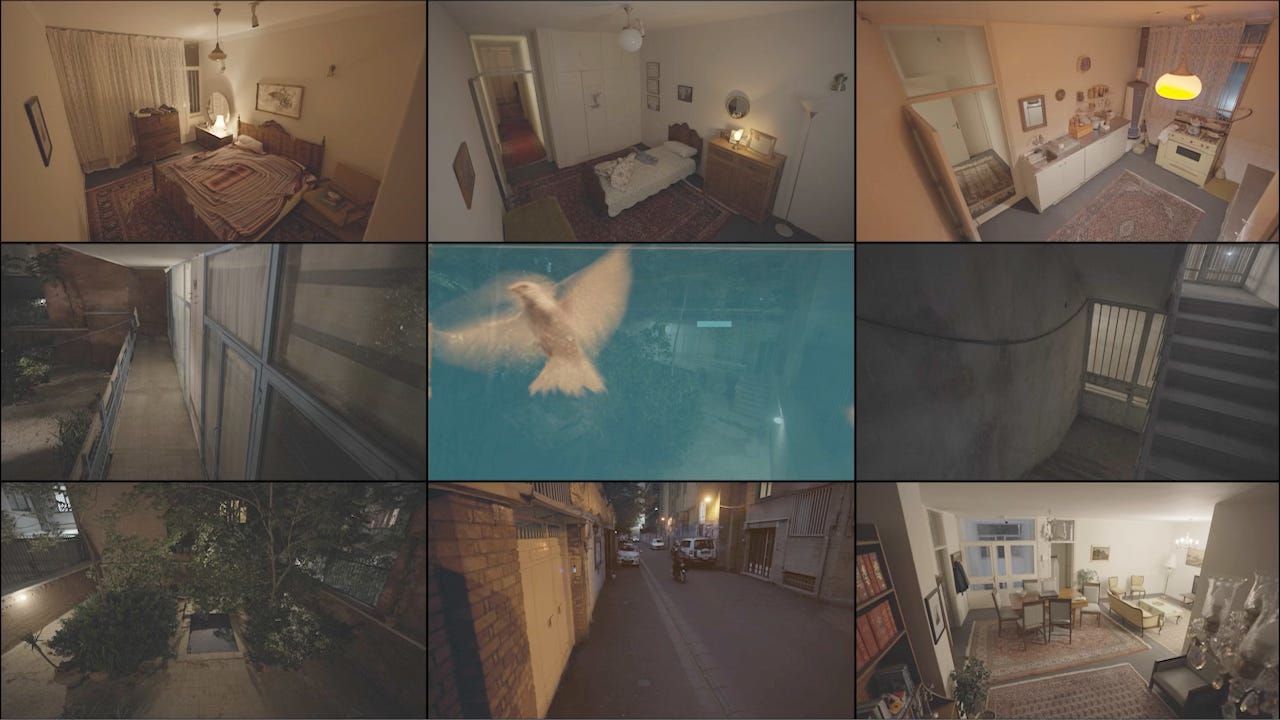
Morteza Ahmadvand and Firouzeh Khosrovani’s Past Future Continuous (2025) does something similar, creating a connection with a homeland by building a personal portrait of a home, and in doing so, expressing something of the collective suffering that comes from a state or body that splits families apart. And like Khoshnoudi does with the form of The Vanishing Point, Ahmadvand and Khosrovani find a creative solution to the artistic challenge of not being able to work in the place they want to make the film about, and not being proximate to the family that they want to film. Created almost entirely using surveillance-style webcam footage in which different rooms of the same home and their inhabitants are seen voyeuristically from various corners of the house, Past Future Continuous is a meaningfully imperfect portrait of a place. Much like how a video call with someone is only an approximation of talking with them in the same room, it is disjointed, disconnected, and distanced by design.
Documentarian Firouzeh Khosrovani lives in America, having left Iran for Italy as an adult. Video artist Morteza Ahmadvand is based in Tehran. Their international collaboration first presents itself as a first-person documentary, but not from the exact perspective of either of the pair. Past Future Continuous unfolds as an edited together montage of moments in which the film’s narrator voice, Maryam, a member of a marginalised group who escaped Iran in 1979 and is now unable to return, observes her aging parents in Tehran, talking about them while viewing them via the eight household cameras, or simply keeping watch over them like some kind of guardian angel looking down from the God’s eye view of the closed circuit camera network she has constructed, Big Brother-like, throughout the white brick compound that is their home. But the film is instead a fiction of sorts. Maryam is a character created by the filmmakers, and her parents are actors, playing out their roles within the architecture of a home that serves as a studio backlot-like set for a stage play set within the confines of a home. The film’s narrative construct acts as a stand-in for the experience that many in Iran have had, of separation and distance, of unbridgeable physical and emotional divides. The Maryam of the film could be Bani Khoshnoudi, or any of the many Iranian filmmakers unable to return to Iran, but more than this, she is an avatar metaphor for anyone anywhere separated from their family, forced to connect with them only through audio and video mediated through semi-connective virtual screens.
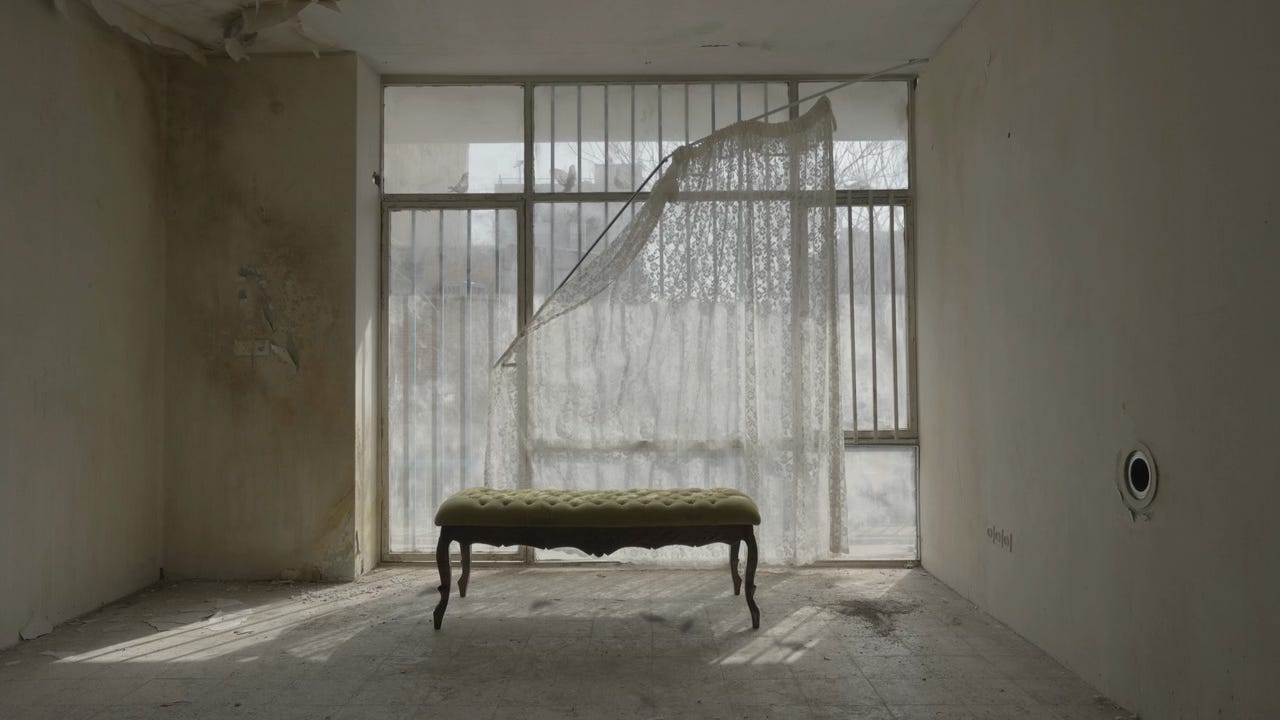
Past Future Continuous starts in a similar fashion to how The Vanishing Point does, with rainfall seen from inside a home that is dilapidated in a manner that suggests memories hidden behind the plaster that patches the cracked storied walls. In a static shot, we see a shattered window that looks over a rocky landscape of tower blocks with snow-covered mountaintops behind them. On the windowsill, among the glass shards, rests a dark feather and what looks like a dead bird. A poem is read aloud that speaks of a “dark city” and “two windows that await” a “painful return,” before thunder breaks and a piano track kicks in, triggering a fade-to-black and the film’s title card. As with The Vanishing Point, this introduction serves to set the mood and embed a melancholic tone that persists long after it the film begins in earnest, switching to the security camera footage as Maryam introduces the conceit of the film, explaining her exile and how with the installation of the webcams she hopes to achieve two things: a means of virtually “returning home” and keeping her octogenarian parents “alive with her gaze.”
The parents potter around their home, cooking, chatting, watching television, and at one point, dancing, seemingly purely for the amusement of their onlooker. Maryam narrates their experience, describing her memories of the family’s past and her relation to this witnessed present, teasing out details of the state of the nation that has caused her to foster this imperfect connection with her parents living out their last days. Occasionally, archival home movies of unknown providence are interspersed to visualise the described past. One particularly moving sequence staged via the theatre of cross-cutting security cameras details an attempt to arrange international travel, interrupted by illness and a near-death experience, all witnessed distressingly from the camera network mounted high up above. In a less effective moment and a quite an on-the-nose symbolic gesture, Maryam purchases them a parrot in an attempt to break the silence of the home—a bird within a cage within a cage.
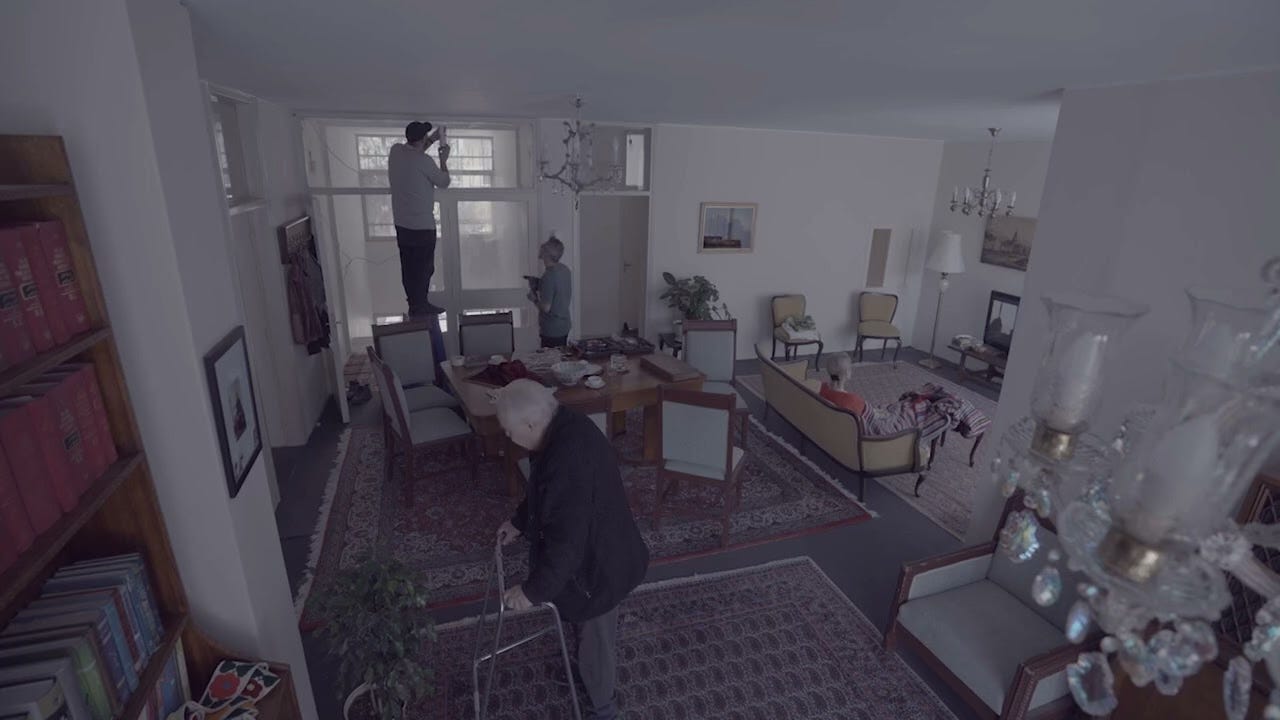
The security camera setup is a peculiar, sometimes perverse, conceit, immediately producing a striking aesthetic that creates many strange visual connotations, among them the worlds of reality television and early experiments in durational “lifestreaming,” but also phenomena like GhostCams, livestreams, or even the isometric perspective of household management games like The Sims. It also evokes the many films made during the pandemic period in which screens are used to connect the isolated and experiment with novel “cameraless” kinds of film forms. And also of course Jafar Panahi’s various experiments—This Is Not a Film (2011) and Closed Curtain (2013) among them—in creating films clandestinely under conditions of surveillance by the state. Within the context of Past Future Continuous, wherein the cameras are installed to watch over distant parents across a specific international divide, it becomes an act of self-surveillance within a dictatorship that, instead of being complicitous with the state, somehow becomes a liberatory reconciliatory expression and an act of care. “In the early days,” explains Maryam, “this digital reunion reawakened emotions in me that years ago, to survive in exile, I had suppressed.” But this connection, described by the narrator as a state of being “present-absent,” also proves torturous too. The pleasure of being able to reconnect with family also means entering a “cocoon of loneliness” in which Maryam is made passively privy to their sadnesses, weaknesses, and moments of greatest dejection and despair. It is not a true connection, but the embodiment of a kind of threshold, a liquid crystal bubble representative of the bargain with the Devil we engage in when replacing physical presence with screens, sacrificing proximity, intimacy, and touch.
The fictitious premise of Past Present Continuous, veiled initially but slowly made evident, is not a trick or toy. It is instead a device to universalise a single person’s story, such that it acts as a conduit for the feelings of all those who find themselves torn away from their loved ones. It is also a means to address a complex topic in a novel and safe manner while also avoiding the moral uneasiness of actually surveilling your own family and presenting their most private moments for public consumption in an international film festival context. In a Q&A for Past Present Continuous, Khosrovani said that “Maryam is lots of us: me, some of you,” and noted that the film was about how migrants often remain in conversation with their homelands. The film’s credits describe the parents’ role as “reenactment actors,” so we can assume these characters, this setting, and this concept are a composite of the directors’ experiences of some kind, an approximation of the real created through a flawed but affecting docufictional container that can encompass a more slippery and expansive reality than simple observation or capture could allow.
The Vanishing Point (Bani Khoshnoudi, 2025) had its premiere at Visions du Réel, where it won a Jury Prize in the Burning Lights competition. It has since screened at many other festivals, including Dokufest, Doclisboa, and IDFA. More information about Bani Khoshnoudi can be found here. Past Future Continuous (Morteza Ahmadvand and Firouzeh Khosrovani, 2025) had its premiere at the Venice Film Festival, in the Giornate Degli Autori section. It won the top prize in the Envision competition at IDFA. More information about Firouzeh Khosrovani can be found here. To receive more articles like this, please subscribe. The writing in this newsletter will always be free-to-read, but donations are very welcome.
Fantastic analysis of how these films invert surveillance from oppression into tenderness. The 'present-absent' concept really nails somethng I've been thinking about since moving away from my family,how screens give us access but never closeness. What's intriguing is how Khoshnoudi and the others turn the regime's own panopticon logic back on itself, not to control but to care across imposed distance. I dunno if that fully resolves the ethical tension but it's a compelling reframing.